|
Manual in German
|
MX31 Start of Production
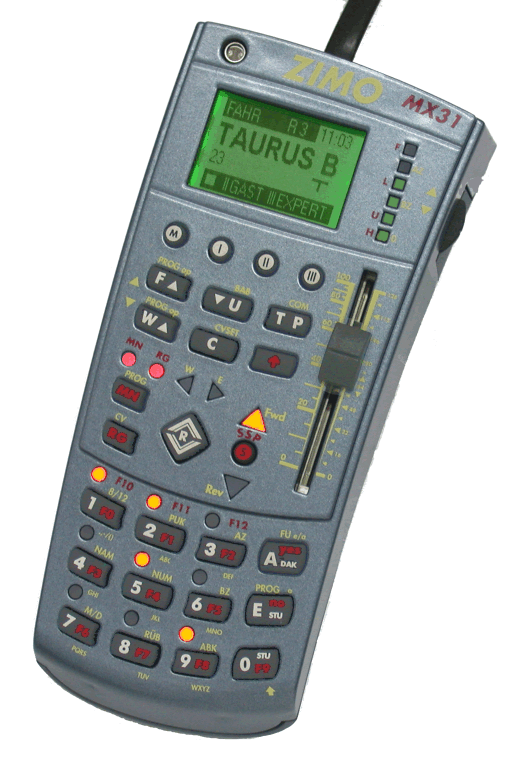
The picture on the left
shows the first production MX31
Production has started in August and with it dawns a new era for ZIMO
systems (as well as for DCC control in general...).
The MX31 represents a great leap forward in technology, ergonomics
and design but does not renounce experiences gained from building
5 generations of ZIMO cabs over the last 25 years.
Our product philosophy is
represented by high quality equipment as well as proven and
innovative concepts. ZIMO doesn’t
offer minimum function
handhelds
just to get the prices down |
|
The
following section lists some typical characteristics and features, which
illustrates the status of the ZIMO MX31 in comparison to handhelds,
cabs, stations and “mice” of the competition. This list is neither
complete nor compiled according to significance:
NOTE: Not all planned features
are operational when delivery commences in 2005. ZIMO's concept of a
continually evolving system will bring new software updates in the course
of this and next year. These updates will be available to ZIMO users
at no charge and may also contain changes to the original planned
projects. The ZIMO Service Tool program (ZST) is designed to facilitate
the update procedure.
-
Unrestricted access to all functions within a ZIMO system (true for all
ZIMO cabs): driving, switching, programming, block control, automation.
-
Two main
operating modes (OPERATOR and EXPERT) with their aim of “basic functions
– comfortable and simple” or “maximum information - largest range
of functions”; as well as the “GUEST” mode for the control of one
pre-assigned train only.
-
Assignment
and use of names not just for locomotive and turnout addresses but also
for trains (consists), turnout ladders and in the future for other
elements as well (e.g. operating sequences).
-
Keyboard
illumination, automatic dimming of LED’s and display (daylight sensor),
readable in full sun light.
-
Background
memory can be superimposed and scrolled through (list of locos and
accessories stored in the background memory, ready to be activated) at
the same time a loco or accessory address is active; switching to a
selected background address is possible with just one keystroke.
-
Simultaneous control of two locos (incl. graphical representation),
speed/direction with speed slider/directional key or encoder wheel
respectively, particularly suitable for shunting activities and consist
building.
-
Accessibility of most application levels either through a comprehensive
menu structure with integrated help files or by direct acting key
combinations.
-
Programming
mode (service mode and operational mode) with "command line memory" to
simplify experimental changes in coherent decoder CV’s that also allows
copying to other addresses.
-
Integration
of the bidirectional communication in the areas of “driving”,
“switching” and “programming”. Numerical display of target speed and
actual speed as well as indicators for automated signal stops and brake
sections. Fast clock, selectable as local time or synchronized
system-time.
-
Special
procedures for the definition and activation of different “automated
operating sequences”, which are processed by the command station (ABA,
ARA, block control, future features….).
-
Multilingualism, probably with an option of adding phrases in your own
slang.
-
Software
updates via Internet and command station with the help of the ZIMO
Service Tool (ZST), no charge of course.
The development of a
radio version MX31FU
will be completet a few weeks after the release of the MX31 cab (a
US/Canada version will take a little longer), with notably higher battery
capacity compared to the MX21FU but all the advantages of the new
generation. |